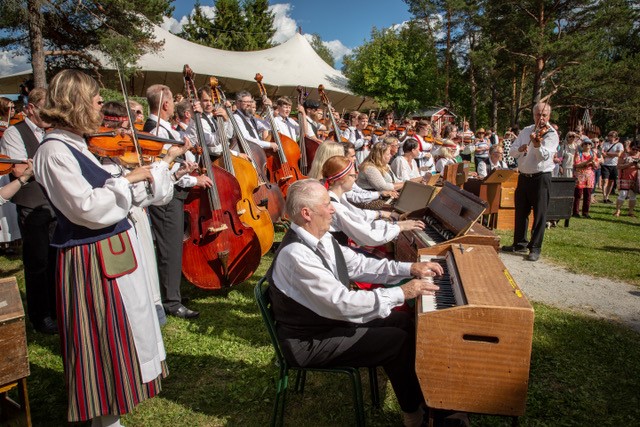
The opening concert of the festival in 2018 (Photo: Risto Savolainen)
This spring, Finland submitted a proposal to UNESCO to add the Kaustis violin to the list of the Intangible Cultural Heritage of Humanity - for global attention. The entire Kaušti community of musicians, dancers, singers and others was heavily involved in the preparation. The nearly two-year process and everything related to it can be read on the application blog. The application video is also worth watching.
So, before Christmas 2021, will the players from Kaustis be given a handsome Unesco stamp on their asses, which will put them on a pedestal to be admired? Will the Kaustinen Folk Music Festival become a celebration of Kaustisian folk music, where everything else is somehow a less valuable bonus?
The people of Kaustis have probably always had a special place at the festival, thanks to the home field advantage, the number of players, the spectacular joint numbers, the mythical reputation of the place and top figures like Konsta Jylhä. The event was founded on and around the Kaustis tradition, and many people still see it as the heart of the festival.
What happened in the following years, however, may have been a bit of a surprise to everyone. Callers wandered to Kaustinen from one direction or another, by the hundreds, by the thousands, and have been wandering ever since. At the time of its foundation, big things were thought of, but did they see that the festival would become a Mecca for folk musicians, a pilgrimage destination for everyone?
The festivals are attended by a large group of established players and listeners with their own routes, routines and rituals. They do not revolve around the Kaustis poles but have settled in, made the festival their own, their home turf as much as the locals. Kaustisans do not have a monopoly on Kaustice, fortunately for everyone.
Perhaps the people of Kaustis enjoy (mostly secretly, in the style of Central Ostrobothnia) their small special status, but they certainly enjoy the way everyone else has embraced the festival. With the festival cancelled this year, the people of Kaustis, not just the cashiers, will miss their guests at least as much as the guests from Kaust.
The Unesco stamp will hopefully attract many new people to take an interest in the Kaustis tradition and thus in the festival in the future. Perhaps they will come to see the ”famous” thing, which has been properly put on the UNESCO list. What will happen when they come?
Sure, they see the musicianship of the Kaussians, but they also see everything else. No one who comes to the festival escapes the overwhelming collective buzz of creativity, musical joy and interaction that makes it a party. It lifts the kaustis musicians even more than if they were playing alone, and it doesn't matter where each musician comes from. There is no reason to doubt that this will continue to be the case in the future.
Text:
Lauri Oino
Producer, Folk Music Institute