Seminars 2026
The Kaustinen Folk Music Festival's seminar programme offers a wide range of perspectives on topics, issues and developments in the field.
The program consists of five seminars, which are free to attend. The seminars will be held in either Finnish or English. All seminars will be held in the Museum Hall or the Kaustinen Hall in the Finnish Folk Art Centre.
Tue 14.7. 12-13.30, Museun Hall
Döda notböckers säkllskap Seminar

In Finland, approximately 70 hand-written scorebooks from the 1700s to the 1800s have survived. They contain unique folk music dance programs, but the material is scattered in archives and private collections – often difficult to find and only partially digitised. Döda notböckers sällskap is a network that maps and documents these scorebooks, as well as promotes their digitisation and accessibility. The goal is to bring the "dead" scores back into their rightful place – to support research, teaching and performance activities, and to build a clear path to this forgotten repertoire. The network presents itself at the festival with a seminar and a concert, where the old material is given new life.
In connection with the seminar on Tuesday, the scorebook by Samuel Rinta-Nikkola, edited by Roope Aarnio, will be published – Näköissivut and new interpretations. The folk collection compiled by the blacksmith from Ilmajoki Samuel Rinta-Nikkola in 1809 is one of the secrets of the SKS archive and a cornerstone of Finnish folk music. The publisher of the new work is the University of the Arts and it is part of the Sibelius Academy’s Folk Music Publications series.
The seminar will also present the rest of the club's activities, as well as Anders Juurela's scorebook from Anjala, which was published this spring at the Lempo festival in Kuopio.
At the end of the seminar and at the concert in the PH Nordgren Hall on Wednesday at 8:45 p.m., members of the club will play music found in old sheet music books.
Tue 14.7. 16.00–18.30, Museum Hall
VISIO2030

The seminar bringing together actors in folk music and folk dance will unveil the new target program for the field, Visio2030. How should the field prepare for the changes in the funding environment, the increasingly accelerating digital transformation, and global uncertainty? How can the themes of cultural security, national identity, and well-being be articulated and meaningfully integrated into the field’s activities? The seminar is organized by the Folk Music and Folk Dance Promotion Center and the Folk Music Institute. The seminar language is Finnish.
Thu 16.7. 17-19.30, Museum Hall
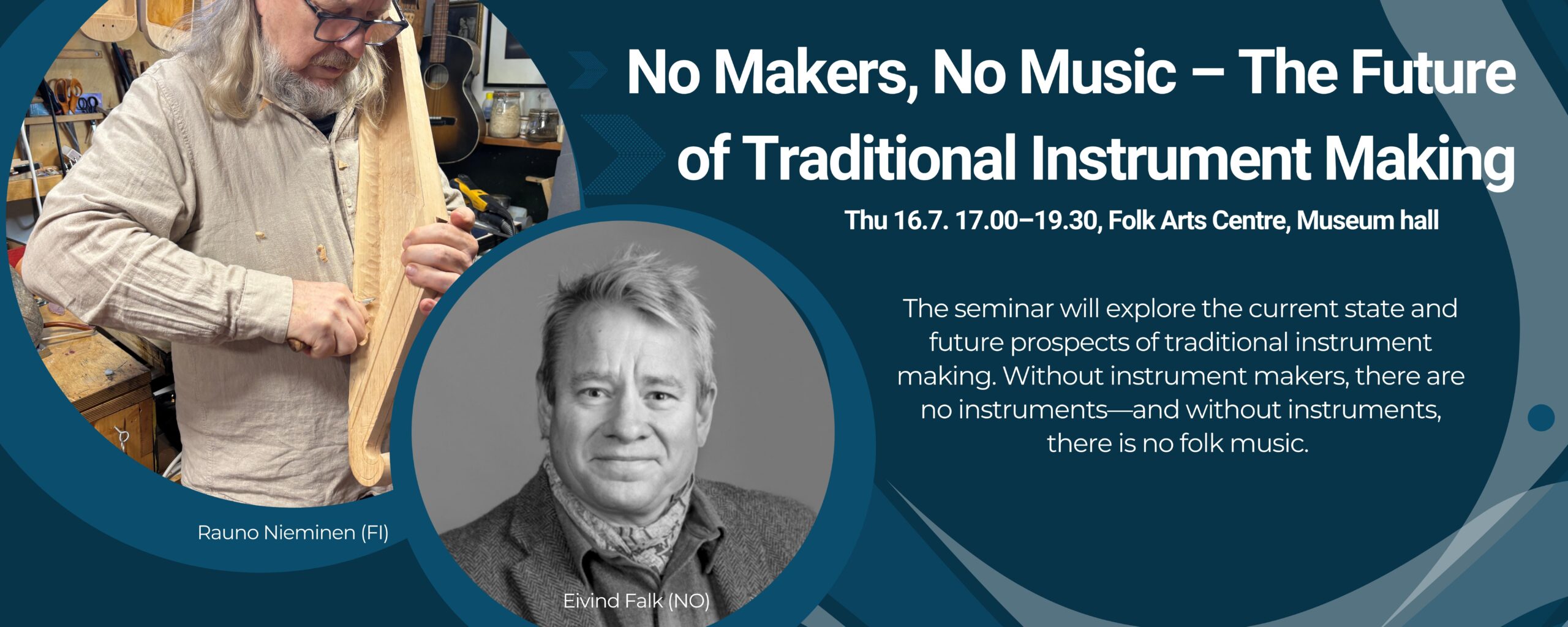
No Makers, No Music – The Future of Traditional Instrument Making
The seminar will explore the current state and future prospects of traditional instrument making. Without instrument makers, there are no instruments—and without instruments, there is no folk music. How could the concept of living heritage and the 2003 UNESCO Convention offer new ways to highlight the significance of the instrument-making tradition in Finland, the Baltic countries, and the Nordic countries? What kinds of international networks are needed, and how should education in this field be organized?
17.00 Welcoming words
17.10 Rauno Nieminen – Traditional instrument building in Finland
17.40 Eivind Falk – The art of safeguarding a flute
18.20 Panel discussion – Strategies for Safeguarding Traditional Instrument-Making – Networks, transmission and education.
Chair: Matti Hakamäki
Panelists: Henna Tahvanainen (FI), Ilmas Pumpurs, (LV) Eivind Falk (NO), Michael Sibanda (ZA), Sanni Virta (FI)
19.00 Questions and answers
19.30 Closing the seminar
Rauno Nieminen offers reflections on folk instrument making in Finland, past and present. When traditional instrument maker Teppo Repo died in the 1960s, it was reported that the last Finnish folk instrument maker had passed away. A new generation of instrument makers emerged in the 1970s, but the question now is whether a further generation will follow them. In Finland, the challenge boils down to the lack of a professional, sustainable business model for folk instrument making — though encouraging examples do exist, particularly in kantele building.
Eivind Falk will present examples of safeguarding practices related to musical instruments, from the Bigwala trumpet in Uganda to the Norwegian willow flute. His examples are collected from his work as an Editor-in-Chief for the by UNESCO accredited NGOs journal #HeritageAlive, and their publication on Musical Instruments.
In the panel, experts from Latvia, South Africa, Norway and Finland will discuss the seminar's theme. How is the craft of traditional instrument making being safeguarded for future generations, and what projects and examples offer inspiration? How could the concept of living heritage and the 2003 UNESCO Convention offer new ways to highlight the significance of instrument-making traditions in Finland, the Baltic countries, and the Nordic countries? What kinds of international networks are needed, and how should education in this field be organized?
Thursday 17.7. 12.00–14.30, Kaustinen Hall
Place, heritage and sustainability - cultural security in Finland's future

Seminar Place, Heritage and Sustainability – Cultural Security for the Future in Finland addresses cultural and spiritual security in today’s rapidly changing world. The focus is on how to promote cultural sustainability and what role culture, Finnish identity and cultural heritage have in safeguarding the vitality and resilience of society. How should different regions and provinces position themselves and respond in the new situation?
Today, culture and cultural heritage are increasingly recognized as a key component of the overall sustainability of society – including national defense. For a small nation like Finland, upholding its culture and cultural heritage identity is a matter of survival. What alliances does Finland need in the future, and what contribution can cultural actors make to future international cooperation? How can we ensure that everyone continues to find meaning in a society that is increasingly diverse and rapidly transforming through technology?
The seminar is organized by the Kaustinen municipality, the Kaustinen Folk Music Festival, and the Folk Music Institute. Admission to the seminar is free, and participation does not require separate registration.
12.00 Welcome remarks
12.05 Kaustisen Näppärit
12.10 Introduction to the seminar topic – Matti Posio, editor-in-chief of Keskipohjanmaa
12.30 Panel 1: Experts at the topic
Chairperson: Rosa Meriläinen
Panelists: Teuvo Arolainen, Kimmo Levä, Toni Peltoniemi, Kaarlo Hildén
13.20 Panel 2: Cultural maintenance assurance – perspectives from decision-makers
Chairman: Antti Huntus
Panel members: Mari-Leena Talvitie, Antti Kaikkonen, Sara Seppänen, Tiina Isotalus
14.10 Public discussion
14.30 The seminar ends
Sat 18.7. 11-13.30, Kaustinen Hall
Kaustinen Intangible Cultural Heritage Seminar 2026: Festivals – Living Platforms for the Safeguarding of ICH
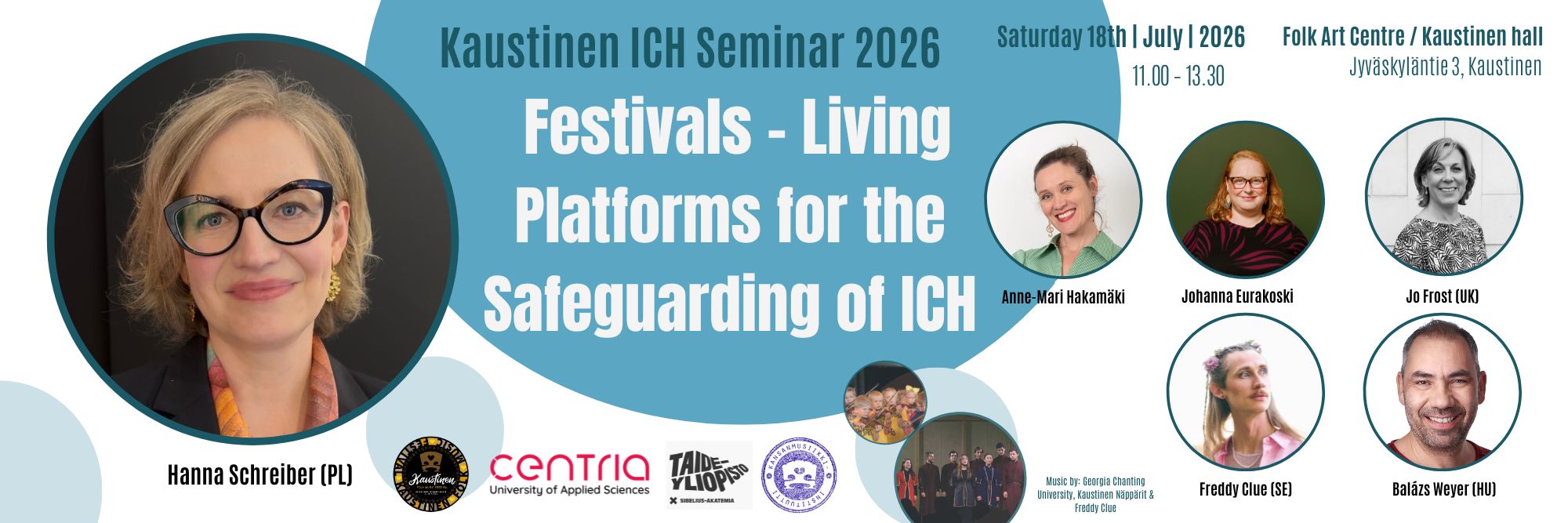
The seminar will examine the role of events and festivals as platforms and tools for the safeguarding of intangible cultural heritage. The seminar will highlight what the 2003 UNESCO Convention and the concept of living heritage can offer music events—including increasing interest among a broader and more diverse audience and strengthening the social significance of festivals. The keynote address will be delivered by Professor Hanna Schreiber (Poland), and a panel discussion on the topic—moderated by Anne-Mari Hakamäki, program director of the Kaustinen Folk Music Festival—will feature Jo Frost, a longtime journalist for Songlines magazine (United Kingdom), musician Freddy Lundh (Sweden), Balázs Weyer, director of the Hangveto organization (Hungary), and Johanna Eurakoski, program director of the World Village Festival in Helsinki. Musical entertainment will be provided by Choir of the University of Chanting (GE) and Näppärit group from Kaustinen.
The seminar will be streamed at the Finnish Folk Music Institute Youtube channel.
11.00 Matti Hakamäki: Welcome to the seminar
11.05 Choirs of the University of Chanting (GE)
11.15 Hanna Schreiber (PL) – Living Heritage and the Paradox of Participation: Are our Festivals Democratic Enough?
11.50 Children group Näppärit from Kaustinen
12.00 Panel Discussion – Festivals and Safeguarding of ICH. Programme Director Anne-Mari Hakamäki will host a panel discussion where musicians, festival organizers and experts from different fields reflect on the seminar theme. The panelists are musician Fredy "Clue" Lundh (SE), Balázs Weyer (HU), Jo Frost (UK) and Johanna Eurakoski.
13.10 Questions and answers
13.25 Closing music – Fredy Clue (SE)
Link to the seminar on YouTube: https://youtube.com/live/rLOLx793hWo?feature=share
The seminar will be streamed on the Finnish Folk Music Institute YouTube channel.
channel: @kansanmusiikki-instituutti898